It has aircraft utilisation target of 16 hours as against the current 13 hours.

The decision has been taken after Kamra was found 'guilty' for alleged misbehaviour by an internal committee of IndiGo, an airline official said. The ban on Kamra comes into effect immediately.

An alternate aircraft of Indian budget carrier SpiceJet flew to Dubai from Karachi's Jinnah International Airport on Tuesday night, ending a wait of nearly 11 hours for 138 passengers who got stranded there after taking off from New Delhi in the morning.

rediffGURU Dr Vivek Mahajan, interventional cardiologist at Fortis Hospital, Kalyan, explains how young Indians can correct their lifestyle in order to protect themselves from sudden and unexpected cardiac arrests.

Jet Airways, IndiGo have gained market shares as SpiceJet cancels flights.

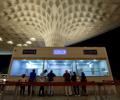
GoFirst, AirAsia India, Star Air and TruJet will resume all their domestic operations from Terminal 1 from October 20 midnight, the private airport operator said in a release.

Tata group-owned AirAsia India's inability to get approval for international flights is hurting UDAN, the Indian government's regional air connectivity project that also aims to link cities in Northeast India and Odisha to places abroad. Sources said the civil aviation ministry is waiting for the low-cost airline to come under the full ownership of Tata Sons and become part of Air India, the former state-owned carrier now owned by the private conglomerate, before allowing it to operate international flights. Tata owns 84 per cent stake in AirAsia India and it is understood that the group will complete the process of buying rest of the stake by July's end.

A passenger called Himadri Barman tested positive on Tuesday, and Nagendra Singh tested positive on Wednesday, said the director of Netaji Subhash Chandra Bose International Airport.
The airline said it has filed a police complaint about the incident, but did not specify when the 30-day ban came into effect.

Trinamool Congress national spokesperson Saket Gokhale was earlier arrested in December for a tweet endorsing an alleged fake news report about Prime Minister Modi's visit to Gujarat's Morbi town after the collapse of a suspension bridge in October. Gokhale was detained at Jaipur in Rajasthan and taken to Ahmedabad before getting a bail.
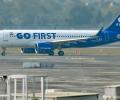
This is the third incident of technical malfunction on a Go First aircraft in two days.
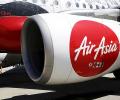
Tata Group-owned AirAsia India, which is in the process of being merged with Air India Express, has taken short-term loans worth Rs 630 crore during the last six months to deal with cash crunch. AirAsia India has been making losses since its first commercial flight on June 12, 2014. Its net loss increased by 42 per cent to Rs 2,178 crore in FY22.

India has evacuated at least 670 Indian nationals from Sudan and is looking to rescue more of its citizens from the strife-torn African nation before the end of a tenuous ceasefire between the regular army and a paramilitary force.
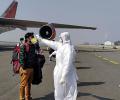
The load factor of six major domestic airlines--IndiGo, SpiceJet, Air India, GoAir, Vistara and AirAsia India -- stood between 70 per cent and 64.9 per cent in January.
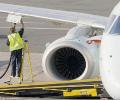
With airlines reporting multiple technical malfunction incidents, aviation regulator DGCA on Monday said it conducted spot checks and found that there is an insufficient number of engineering personnel certifying planes of various carriers before their departure. Before each departure, an aircraft is checked and certified by an aircraft maintenance engineer (AME). The DGCA has now issued guidelines for airlines on the deployment of AME personnel and directed them to comply by July 28.

Its association with India is over 70 years old and spans both civil and military aviation. The Douglas DC-3 transport aircraft used by the air force beginning the 1940s and the iconic Boeing 747 aircraft flown by Air India, both had Pratt & Whitney (P&W) engines. The Indian Air Force's present-day, heavy-lift C-17 Globemaster III and the yet-to-be-inducted C-295 planes, too, have P&W power plants.
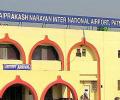
A UN team had visited the Patna airport and expressed concerns.

Around 200 pilots of Go First, the cash-strapped airline that suspended operations on May 2, have joined Air India. As many as 75 of them started training with the Tata-owned airline on Monday. As Go First tries to salvage its operations, it has announced additional pay or retention allowance of Rs 100,000 and Rs 50,000 for captains and first officers, respectively, with effect from June 1.
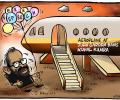
Uttam Ghosh offers his take on the decisions of airlines banning stand-up comedian Kunal Kamra for his alleged heckling television journalist Arnab Goswami aboard a flight on Tuesday.
When the Tatas re-boarded Air India on January 27 last year, the price of aviation turbine fuel was at over Rs 80,000 per kilolitre. Rupee was trading at around Rs 74 to a US dollar. The Omicron variant of Covid-19 was in prevalence - barely a week earlier, India had reported over 340,000 cases on a single day. Seven-day home quarantine of international travellers was the norm.

While IndiGo carried 16.82 lakh passengers, a 59.4 per cent share of the total domestic market, SpiceJet flew 3.91 lakh passengers, which is 13.8 per cent share of the total market, the DGCA data noted.

The official data maintained by the Centre-run System of Air Quality and Weather Forecasting And Research put the condition at severely polluted. The Particulate Matter 2.5 level was recorded at 146 while the PM 10 was at 233 in New Delhi.

"Unless he tenders an unconditional apology to AI employees, and undertakes in writing to abide by the Chicago and Tokyo Conventions & Rules of the Air and follow all cabin safety and public behaviour norms, we must not let him on board," says the letter.
The DGCA conducted the spot checks as there have been many technical malfunction incidents in Indian carriers' planes during the last 45 days.

Justice Naveen Chawla disapproved of Kamra's behaviour on the flight and said it 'cannot be permitted on an airline'.
Air India, IndiGo, and SpiceJet have suspended flights to China and Hong Kong.

The order, valued at 'nearly $9 billion at list prices', was signed at Dubai Air Show 2021 on Tuesday.
Ending its uncomfortable journey in India after eight years, Malaysia-based AirAsia Group on Wednesday said it has exited AirAsia India by selling its remaining 16.67 per cent stake to Tata Group-owned Air India for Rs 155.64 crore. Later in the day, Air India said it has begun the process of creating a single low-cost carrier subsidiary by merging AirAsia India and Air India Express. A working group consisting AirAsia India CEO Sunil Bhaskaran and Air India Express CEO Aloke Singh has been formed for the two carriers' integration, which is expected to take approximately 12 months, it added.
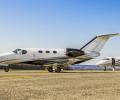
'The need for added safety has bolstered demand for charter flights in the last year and is expected to continue.'

French aerospace major Thales Group is eyeing major expansion in India. The group has started planning to set up a maintenance, repair, and overhaul (MRO) organisation in India to support Indian airlines - many of which are its customers for avionics support. "We are looking to set up an MRO, so that they don't have to travel to West Asia or Singapore. "Final decision is yet to be taken, but this is a clear intent showing the growth potential in India that we are looking to set up a sub-centre here," said Yannick Assouad, executive vice-president, avionics at Thales, who was on her maiden visit to the group's India office at Bengaluru since taking charge.

The company will meet DGCA next week and is putting in place a strategy to contain the damage

Coordination between defence and civilian authorities has freed up airspace for commercial airlines in India, resulting in routes becoming shorter and costs coming down, apart from mitigating pollution. "Due to various restrictions of the military, only about 58 per cent of the Indian airspace was being utilised. It is close to 70 per cent now," said an official of the Airports Authority of India (AAI). Officials of the AAI said to date 119 routes had been shortened. Sources said since December 2020 the cumulative savings of airlines had been close to Rs 200 crore while there was a reduction in emission of around 45,000 tonnes of carbon.

According to a survey by travel portal ixigo, economy airfares from Mumbai have shot up by almost 25- 30 per cent till the end of March.
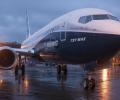
Reduction in fuel price was supposed to bring back good luck for Indian airlines. But with the global spread of coronavirus, airlines are being forced to rejig their network, cut flights, and delay launches.

From rocking body-con dresses to giving us boss lady vibes and slaying the desi look, Namrata Thakker lists her stunning sartorial choices for Liger promotions.

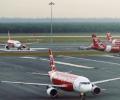
A major mishap was averted on Wednesday when the wingtips of two aircraft -- one of them taxiing and the other on the verge of takeoff -- touched each other at the Mumbai's Chhatrapati Shivaji International Airport in Mumbai.
Air India and IndiGo have already suspended Kamra from flying until further notice and six months, respectively.

If the Murari Lal Jalan-Kalrock Capital combine can script a turnaround, it will have pulled off a bigger coup than Ajay Singh did with SpiceJet in 2014.
Management and leadership changes, in addition to synchronising operations between all its airlines, are showing visible results for Air India. Data from the Directorate General of Civil Aviation (DGCA) show that there has been a marked improvement in key operational parameters of Air India after the Tata group took complete control of the national airline in January. One of the most dramatic improvements has been noticed in Air India's passenger load factor (PLF) - a crucial metric of capacity utilisation of an airline's fleet that shows how many seats it has been able to fill on every flight.
